Why Lamborghini's First Concours d'Élégance Was a Calculated Challenge to Ferrari's Heritage Playbook
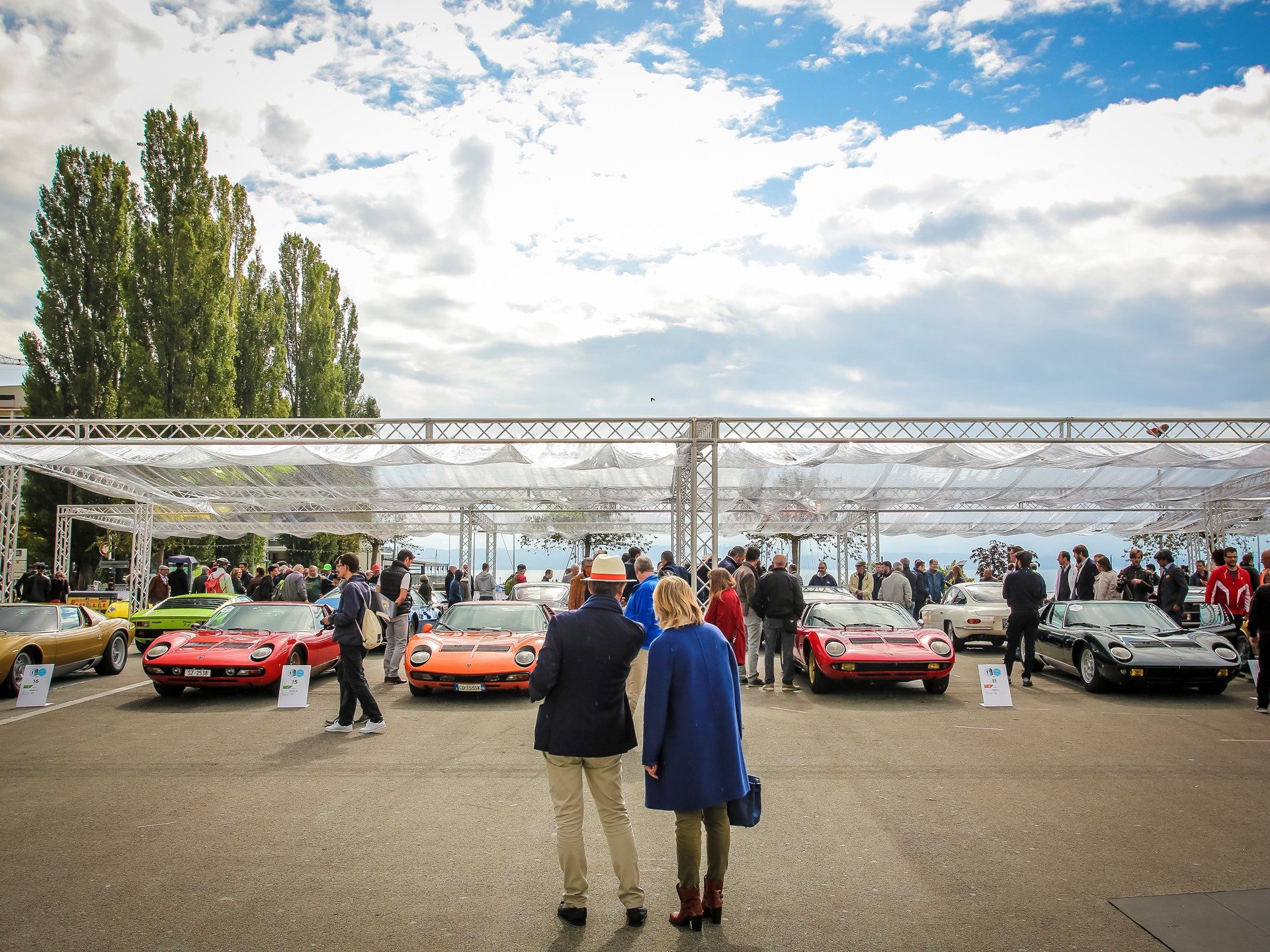
Fifty Lamborghinis lined the shores of Lake Neuchâtel in September 2017, launching a heritage strategy timed to reshape the brand's narrative.
Fifty Lamborghinis gathered at the Place du Port in Neuchâtel, Switzerland, on September 17, 2017, for the first "Lamborghini & Design" Concours d'Élégance, organized by the factory's heritage arm, Polo Storico.
Ferrari's decades-long head start
Ferrari's Classiche program and its commanding presence at Pebble Beach, Villa d'Este, and Goodwood had long used heritage infrastructure to reinforce collector confidence and protect residual values.
Design over racing provenance
Lamborghini sharpened the distinction from Ferrari's heritage playbook: where Maranello's events celebrate racing provenance, Neuchâtel celebrated the act of drawing a line that had never been drawn before.
Building institutional credibility
Polo Storico staged an international event with a distinguished jury presided over by Stefano Pasini and including members such as Alain De Cadenet and Corrado Lo Presto, building the institutional credibility that certification programs require.
Best of Show: the Miura SV
The Best of Show prize went to a 1971 Miura SV in verde senape, serial number 4838, belonging to a Japanese collector, underscoring the event's emphasis on originality and condition over sheer rarity.
The opening salvo in a heritage campaign
Neuchâtel was the opening salvo in a heritage strategy designed to give Lamborghini the same kind of narrative depth that Ferrari had cultivated for decades, timed precisely to prepare the ground for the most consequential product launch in Sant'Agata's history.
Three threads converging in Neuchâtel
The timing involved Ferrari's long head start in heritage curation, a Swiss watchmaking town steeped in design culture, and a Super SUV still months from its official debut.
Polo Storico's first curated showcase
Lamborghini's Neuchâtel event marked Polo Storico's first attempt to create a curated, factory-endorsed heritage showcase, moving the department from a back-office restoration operation to the public face of the brand's heritage strategy.
Le Corbusier's automotive connection
Le Corbusier was a lifelong car enthusiast who designed his own vehicle, the Voiture Minimum, which was displayed at the concours alongside classics spanning decades of Lamborghini production.
Not a one-off experiment
Lamborghini continued this concours tradition with subsequent events, confirming the Neuchâtel debut was the beginning of an ongoing program tied to the brand's ambition of standing alongside Ferrari in the heritage arena.
The Marzal's radical ambition honored
The Marzal prototype, designed by Gandini in 1967 with hexagonal glass doors and a four-seat layout, received the Best of the Best award, making the concours's architectural design thesis tangible in a way no speech could.
Domenicali bridges past and future
Stefano Domenicali described the concours as reflecting a brand that looks ahead while appreciating its legendary past, and he specifically cited the upcoming Urus as the realization of the LM 002's original concept for high-performance SUVs.