100,000 Visitors in a Single Year: How Lamborghini's Museum Became a Brand-Building Machine
The Lamborghini Museum in Sant'Agata Bolognese hit a record in 2017, and the demographics behind it reveal a brand cultivating its next generation.
Teenagers, a growing female audience, and visitors from every continent all showed up in record proportions, pointing to something more significant than a good year at the turnstile.
The Senna show that drew a new audience to Sant'Agata
Titled "Ayrton Senna. The Last Night," the exhibition was a photographic record curated by Formula 1 photographer Ercole Colombo and journalist Giorgio Terruzzi, featuring every race car Senna drove from his debut to his final weekend at Imola.
The factory-tour advantage over rival museums
The museum sits in the same building as the production facility, and the ability to see hand-assembly processes up close is what enthusiasts consistently call the highlight of the experience.
70% international in a town of 7,000
Female visitors rose to over 35% of total attendance, visitors under 18 increased significantly, and 70% of the audience came from outside Italy, all pointing to the museum's emerging role as a gateway for future customers worldwide.
Competing with Maranello and Stuttgart
Ferrari's museum in Maranello and the Porsche Museum in Stuttgart both attract significantly larger raw visitor numbers, but they benefit from locations in major cities or well-established tourist corridors, while every visitor to Sant'Agata Bolognese chose to be there.
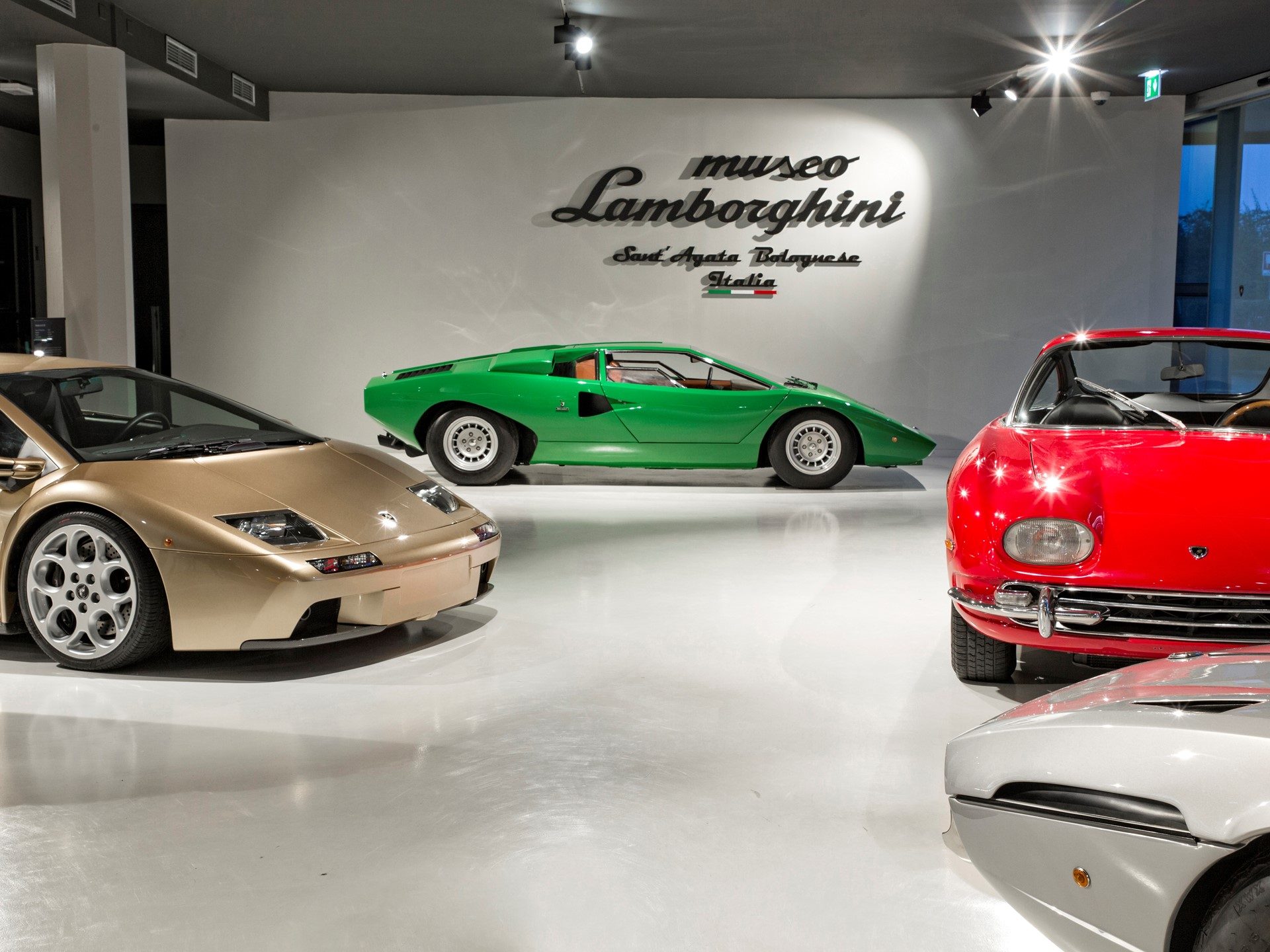
Heritage lineup at Sant'Agata headquarters
Lamborghini confirmed that a program of new exhibitions is in preparation, and the Senna show's attendance spike made a strong case for continuing to use the museum as a rotating cultural venue rather than a static car collection.
Post-Senna: a collection reorganized by engine type
Once the Senna exhibition closed, the museum was completely reorganized with models classified by engine type, tracing the company's history from the 350 GT through to the Urus.
A global audience mapped by the numbers
Italian visitors accounted for 30%, while the rest of Europe (excluding Italy) represented 42%, with Germany at 9%, France and Great Britain at 5% each, Holland at 4%, American visitors at 15%, and Asia-Pacific at 13%.
Intimacy as a competitive edge
Lamborghini's smaller footprint means visitors are closer to the cars, closer to the assembly process, and closer to the sense that they are seeing something not everyone gets to see.
Engineering ambitions beyond the supercar segment
The museum's two-floor layout houses everything from road cars to Formula 1 machines and even marine motors, reinforcing the idea that Lamborghini's engineering ambitions extend well beyond supercars.